

Xiangyang
Ancient Walled City and Zhuge Liang’s Retreat, historic city on the Han River
Located in northwestern Hubei, Xiangyang is a historic fortress city on the Han River, famous for its ancient city walls and the Ancient Longzhong Scenic Area, linked to strategist Zhuge Liang. With a humid subtropical monsoon climate, four distinct seasons and an average yearly temperature around 15–16 °C, Xiangyang is pleasant to visit most of the year, especially in spring and autumn.
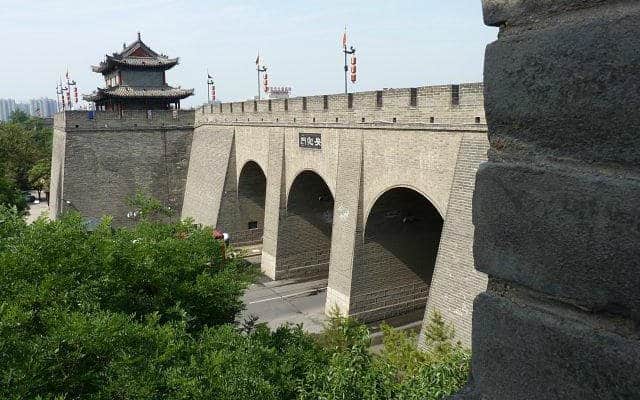
Xiangyang Ancient City – City walls, moats and “Iron Xiangyang”
A 2,800‑year‑old military stronghold
The Ancient City of Xiangyang is a national 4A tourist attraction and a key protected cultural site, with a history of over 2,800 years. It originated as Beijin garrison at the start of the Spring and Autumn period, guarding a strategic passage in the northern Chu state. During the Three Kingdoms era, Liu Biao moved the administrative centre of Jingzhou here, making Xiangyang the “Ancient Capital of Jingzhou”.
At the end of the Yuan and the beginning of the Ming, Deng Yu expanded the city to its current layout, much of which is still visible today.
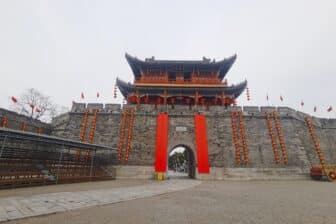
Massive city walls and Asia’s widest moat
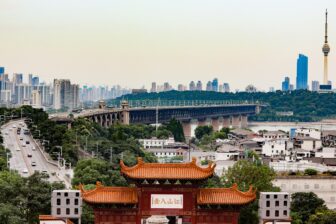
The ancient city wall encloses about 2.56 km², stretching 7,322 m in total length. The wall is up to 10.8 m high (around 9 m on average), 6–11 m wide on top and 11–15 m wide at the base, and is lined with more than 4,000 battlements. Historically, Xiangyang had six main gates, each topped by a gate tower and barbican: Zhenhua, Linhan, Gongchen, Yangchun, Xicheng and Wenchang. Xiangyang’s moat system, sometimes dubbed “China’s No.1 City Moat”, is considered the widest moat in Asia, up to 250 m at its broadest, with an average width of about 180 m, forming a powerful defence system together with the walls.
Han‑Jin culture and Jin Yong’s “City of Heroes”
The ancient city is a cradle of Han–Jin culture and a key battlefield city, having witnessed major conflicts from ancient times through the Mongol–Song wars. It also appears in the martial arts novels of Jin Yong as the “City of Heroes”, and the phrase “Iron Xiangyang” has become synonymous with an impregnable fortress. Within the walls, visitors can explore sights such as the Lady’s City, Green Shadow Wall, Zhaoming Terrace, Dacheng Hall and Xiangwang Palace.
Xiangyang’s humid subtropical monsoon climate brings hot summers, relatively mild winters, and most rainfall in summer, with an average annual temperature around 16 °C, making it possible to visit year‑round, with April–May and September–October particularly comfortable.
Ancient Longzhong Scenic Area – Following in Zhuge Liang’s footsteps
Zhuge Liang’s rural retreat and the “Three Visits”
The Ancient Longzhong Scenic Area, west of Xiangyang, is the legendary retreat where Zhuge Liang spent years studying and farming during the Three Kingdoms period. It is also the setting of the famous stories “Three Visits to the Thatched Cottage” by Liu Bei and the “Longzhong Plan” (Longzhong Dui), where Zhuge Liang outlined his grand strategy. Ancient records describe Longzhong Mountain rising to the west of Xiangyang, whose reputation today is inseparable from Zhuge Liang’s life and the historical anecdotes attached to him.
Stone archway and Wuhou Temple
The stone archway at Longzhong, emblematic of the site, was built in 1875 (19th year of the Guangxu reign, Qing dynasty). Modelled on traditional wooden pailou, it follows a four‑pillared, three‑arched layout, about 6 m high and 10 m wide, with the central inscription “Ancient Longzhong” and side mottos meaning “Simplicity clarifies aspiration” and “Tranquillity leads to greatness”.
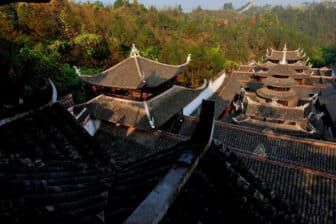
The Wuhou Temple, originally erected in the Jin dynasty halfway up Longzhong Mountain, was rebuilt in 1738 (Kangxi era) by Jiang Xingqi, the inspector of Jingxiang. This multi‑level complex, organised into four courtyards and three main halls, enshrines statues of Zhuge Liang and his descendants Zhuge Zhan and Zhuge Shang.
Zhuge’s thatched cottage, Three Visits Hall and “crouching dragon” scenery
Zhuge’s Thatched Cottage is a Han‑style residence said to be where Zhuge Liang once lived and studied, displaying items symbolically linked to his ingenuity such as wooden oxen and flowing horses and the “First Scholar Tree”; it has also served as a filming location for TV dramas about Zhuge Liang.
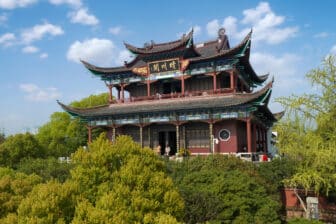
The Knee‑Embracing Pavilion, a hexagonal, triple‑eaved pavilion rebuilt in late Qing times, is traditionally associated with Zhuge Liang reciting the “Ode of Liangfu”, expressing homesickness and lofty ambitions.
The Three Visits Hall (Sangu Hall), constructed in 1700 (58th year of Kangxi), commemorates Liu Bei’s three visits to the thatched cottage and the Longzhong Plan; its couplet reads: “Two memorials honour the Three Visits, one dialogue echoes through a thousand autumns.”
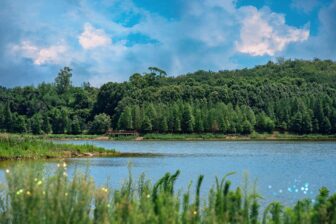
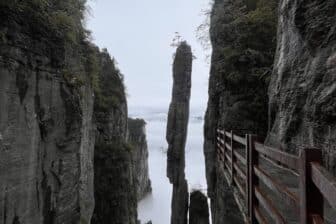
The scenic area also features striking natural landscapes, especially the Crouching Dragon Hill on the southern slope of Mount Leshan, where a stone forest resembles a dragon’s skeleton stretching along the hillside, with a crescent‑shaped spring flowing at its foot.
Longzhong enjoys a humid subtropical monsoon climate, with clear seasonal transitions, ample rainfall and an average yearly temperature of about 16 °C, making it suitable for visits in all seasons, with the best conditions in spring and autumn.