

Xianning
Xianning – Chibi Ancient Battlefield and Jiugong Mountain
Xianning, from Three Kingdoms history to cool mountain retreats
In southern Hubei, Xianning combines historic sites from the Three Kingdoms era with lush mountains and hot springs, making it a relaxing stop between Wuhan and Jiangxi. The city enjoys a humid subtropical monsoon climate with four distinct seasons, plenty of rainfall and sunshine, and an average annual temperature of around 16.8–16.9 °C, so spring and autumn are ideal for travel.
Chibi Ancient Battlefield – Where the Battle of Red Cliffs took place
Legendary battlefield on the Yangtze
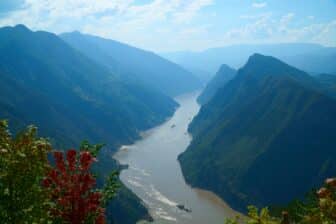
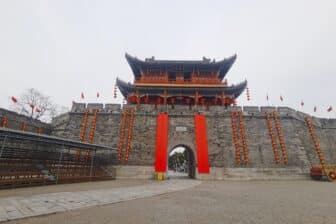
On the south bank of Chibi City, the Chibi Ancient Battlefield is a national‑level scenic site (4A–5A) and the historic location of the Battle of Red Cliffs at the end of the Eastern Han dynasty. Also called “Martial Red Cliff” (Wu Chibi) in contrast to the more literary “Cultural Red Cliff”, it represents one of China’s classic examples of “the few defeating the many” in military strategy. Covering roughly 3–4.7 km² along the middle reaches of the Yangtze River, it is often praised as “China’s No.1 Ancient Battlefield” for both its landscape and preserved relics.
Cliff inscriptions, pavilions and immersive shows
Key highlights include:
-
- The Chibi cliff inscriptions: the two characters for “Red Cliff” carved into the rock are traditionally said to be written by General Zhou Yu; the bold strokes have remained visible despite centuries of weathering.
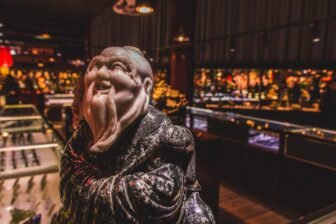
- The Zhou Yu statue, honouring the famous commander of the Wu forces.
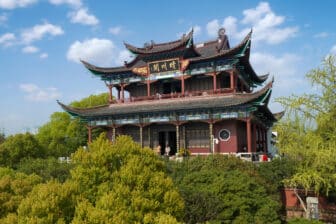
- Yijiang Pavilion, on top of Chibi Mountain, believed to have served as Zhou Yu’s command post, overlooking the Yangtze and Cao Cao’s fleet.
- Wangjiang Pavilion and the Battle of Chibi Exhibition Hall, plus sites such as Wuhou Palace, Fengchu Temple and the Three Kingdoms Sculpture Garden.
In addition to preserved relics, the scenic area offers immersive shows and sound‑and‑light displays recreating the fire attack and naval battle, helping visitors understand the tactics that made Chibi legendary.
Climate and visiting tips
Chibi has a humid subtropical monsoon climate, typically hot and wet in summer and mild but damp in winter, with an average temperature around 16.9 °C and rainfall mainly in spring and summer. The battlefield can be visited all year round, but the misty rains of spring and early summer create especially atmospheric views over the cliffs and river.
Jiugong Mountain – Taoist sacred peak and forest “oxygen bar”
High ridge on the Hubei–Jiangxi border
Jiugong Mountain is a national scenic area, national nature reserve, 4A tourist site and national geopark, located in Tongshan County, at Xianning’s south‑eastern edge bordering Jiangxi. The range forms part of the Mufu Mountains, themselves a sub‑range of the Luoxiao Mountains, and covers roughly 196–210 km². Its main peak, Lao Ya Jian, rises to about 1,657 m, making it the highest point of the Mufu range and one of the tallest peaks in central–southern China.
Forests, cool summers and glacial landforms
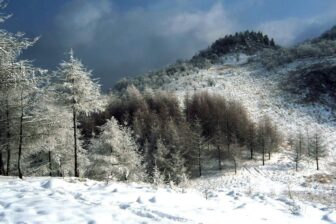
Jiugong Mountain features fault‑block mountain landforms with glacial‑like relief, dominated by granite and metamorphic rocks. With a forest coverage rate close to 96.6%, it is often described as a natural “oxygen bar”, said to have some of the highest negative‑ion concentrations in China – a strong appeal for hikers and wellness travellers. The average annual temperature is around 10–11 °C, and summer highs rarely exceed 30 °C, making Jiugong an excellent summer resort.
The area’s mountain‑type humid subtropical climate brings:
-
- cold winters (sometimes with snow),
- cool, pleasant summers,
- large day‑night temperature differences,
- rainfall mainly in spring and summer.
Taoist heritage and “Nine Palaces” legend
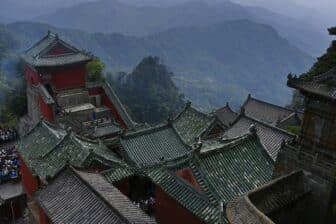
Jiugong is recognised as one of China’s five famous Taoist mountains, alongside Laoshan, Longhu Mountain, Qingcheng Mountain and Wudang Mountain. According to the Taiping Yulan, during the Northern and Southern Dynasties, Chen Bogong and nine brothers built nine temporary palaces on the mountain, giving it the name Jiugong (“Nine Palaces”). In the Southern Song dynasty, Taoist master Zhang Daoqing established a practice centre here, turning Jiugong into an important Taoist bodhimanda and pilgrimage destination.
Scenic areas, temples and wildlife
The scenic area is divided into six main tourist zones:
-
- Zhonggang,
- Yunzhong Lake,
- Shilong Gorge,
- Tonggu Bao,
- Jinji Valley,
- Rebel King’s Tomb.
Signature sights include:
-
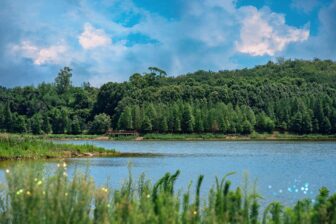
- Yunzhong Lake, one of the highest mountain lakes in central China,
- Dayatou Waterfall, a dramatic cascade considered the tallest in central China,
- the “Welcoming Pine”, a famous solitary tree nicknamed the No.1 Pine of central China,
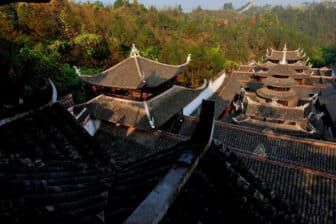
- Ruiqing Palace, an imperial‑era Taoist temple,
- Wuliangshou Chan Temple, a renowned Buddhist temple dedicated to Amitabha and open to international visitors.
Jiugong also preserves primary forests and Quaternary glacial relics, as well as nationally protected species such as the southern yew, the medium‑calyx tree, the white‑necked long‑tailed pheasant and the clouded leopard.
With its mix of mountain scenery, Taoist and Buddhist temples, cool climate and rich biodiversity, Jiugong Mountain is an excellent nature and culture retreat from Wuhan or Xianning in any season.