







Authentic Journey across Nature, History & Spirituality
This itinerary brings together the best of Sichuan, a province filled with contrast and diversity. From Chengdu, the peaceful yet gourmet capital, to the spectacular natural wonders of Jiuzhaigou National Park, UNESCO-listed Huanglong karst site, and historic towns like Songpan. Delve into Buddhist culture in Emeishan, marvel at the Leshan Giant Buddha, experience the ingenuity of the Dujiangyan irrigation system, and be awed by the Shunan Bamboo Sea and Dazu rock carvings. The program blends local encounters, world heritage sites, superb panoramas, and renowned cuisine. It’s a perfectly balanced journey for discovery, serenity, and wonder.
This tour is available in two durations:
- 16 days to follow the full itinerary all the way to the karst landscapes of Wulong,
- and 13 days for a shorter version that still includes the Sichuan highlights. In the 13‑day version, after visiting the Dazu Rock Carvings and the Baodingshan site, you travel directly back to Chengdu (or Chongqing, depending on your flight) for your return, skipping Wulong and departing on day 13.
Daily program: Sichuan Highlights – Tour 13 days
Day 1: Arrival in Chengdu | Altitude: 500m
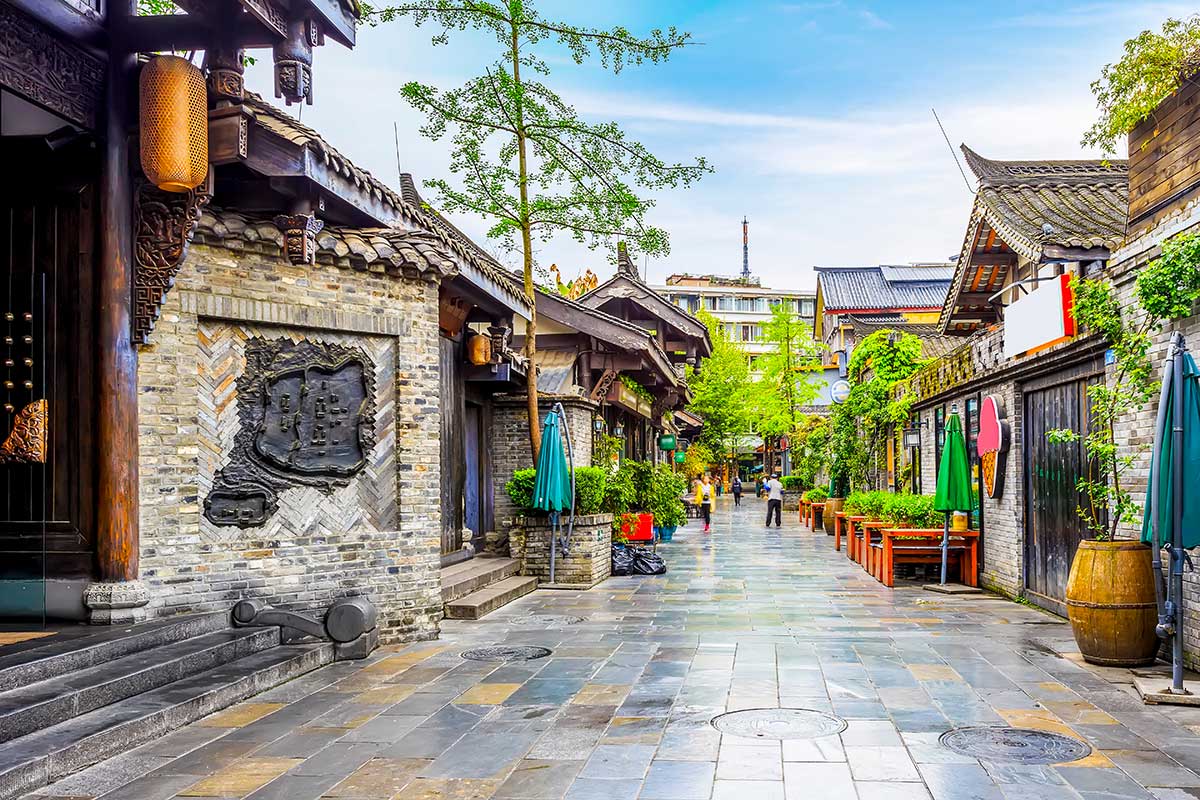
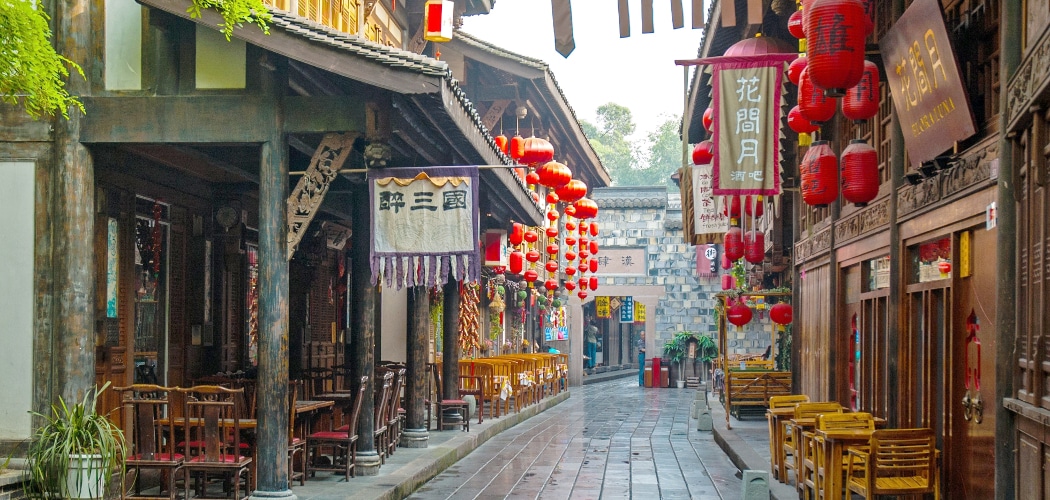
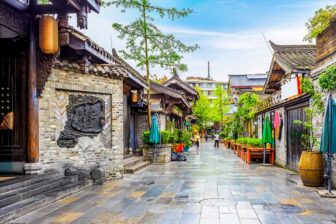
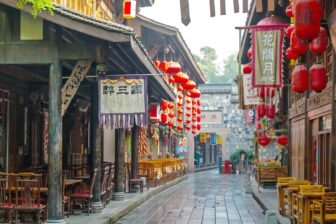
Arrival at Chengdu International Airport, greeting by your guide and driver, transfer to the city center. Chengdu is a city where, once you arrive, you never want to leave. Chengdu is the capital of the “Land of Abundance” (Tianfu) and the center of Western China. Chengdu is renowned for its history, lifestyle, and cuisine. It is in this city that the world’s first paper money, known as Jiaozi, was created during the Song Dynasty. On February 28, 2010, UNESCO named Chengdu a City of Gastronomy. Stroll through People’s Park, the city’s most pleasant green space, featuring floral displays, ponds, and wisteria-draped terraces. If you wish, enjoy a cup of tea while admiring the lakeside scenery. Wander through the Wide and Narrow Alleys (Kuan Zhai Xiangzi), a beautiful example of heritage preservation. This area was formerly the residential quarter for the Manchu army during the Qing Dynasty (1644–1911). Transfer to a charming neighborhood near the theater for an evening Sichuan Opera performance. Overnight: Wenjun Courtyard Hotel
Day 2: Chengdu – Songpan – Jiuzhaigou (Breakfast) | Altitude: 1,900m
Transfer to Chengdu East Station, departure by high-speed train C5762 (09:39–11:12) to Songpan. Arrival at Songpan station and greeting by your new driver. Explore the Old Town of Songpan, nicknamed the “Gateway to Western Sichuan” and the “Ancient City of the Plateau.” It was a key junction on the Tea and Horse Road. Since the Tang and Song Dynasties, it has been a crucial trade point between Han and Tibetan regions, as well as a major stop for the tea-for-horses trade. The current city walls, built in 1379, are 6.2 km in circumference and 12.5 meters high. Constructed using a mixture of sticky rice, lime, and tung oil, they are incredibly sturdy, earning the city the historical name “Songzhou.” A group of statues at the southern wall commemorates the history of the Tang-Tibet matrimonial alliance. Following the Battle of Songzhou, Tibetan King Songtsen Gampo welcomed Princess Wencheng here. Continue to Jiuzhaigou (2.5 hours). Overnight: Rezen Huating Resort Hotel.
Day 3: Jiuzhaigou (Breakfast) | Altitude: 1,900m
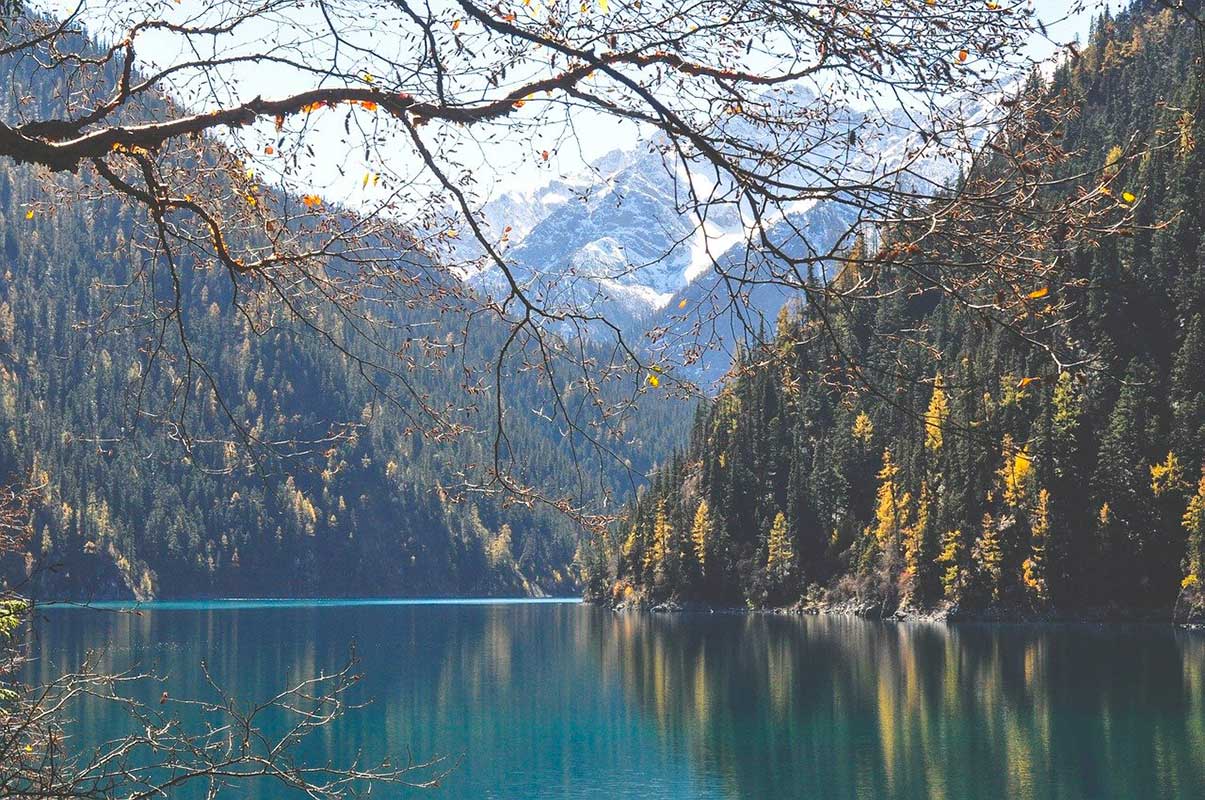
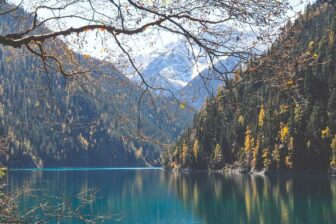
Full-day excursion in Jiuzhaigou National Park, a UNESCO World Heritage site since 1992, whose name literally means “Valley of Nine Villages.” The Jiuzhaigou site, located in the Aba Autonomous Region in northern Sichuan, is known as a “fairytale world” and features the finest water landscapes. It consists of lakes, rivers, and snow-capped mountains, offering breathtaking scenery. Discover Tibetan villages nestled in the valleys, numerous rolling landscapes with hills that change color with the seasons, and various species of wild animals. Many scenic spots such as the Five-Colored Lake, Mirror Lake, Nuorilang Waterfall, and Shuzheng Waterfall are found in the three valleys: Shuzheng, Rize, and Zechawa. These form a “Y” shape: Rize is the right branch, Zechawa the left, and Shuzheng the main trunk. Return to the hotel in the late afternoon. Overnight: Rezen Huating Resort Hotel.
Day 4: Jiuzhaigou – Huanglong – Chuanzhusi – Chengdu (Breakfast) | Altitude: 500m
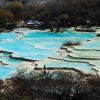
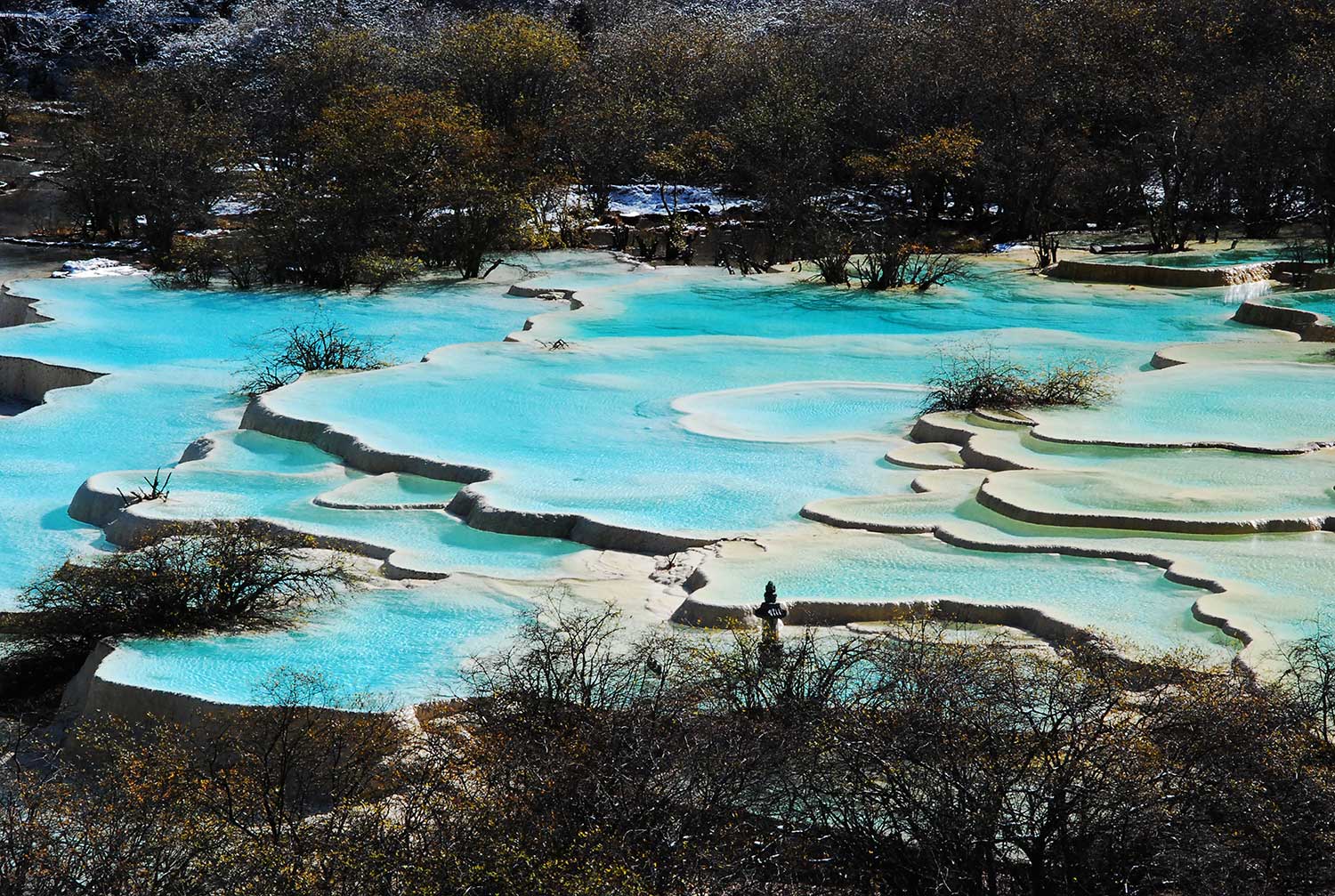
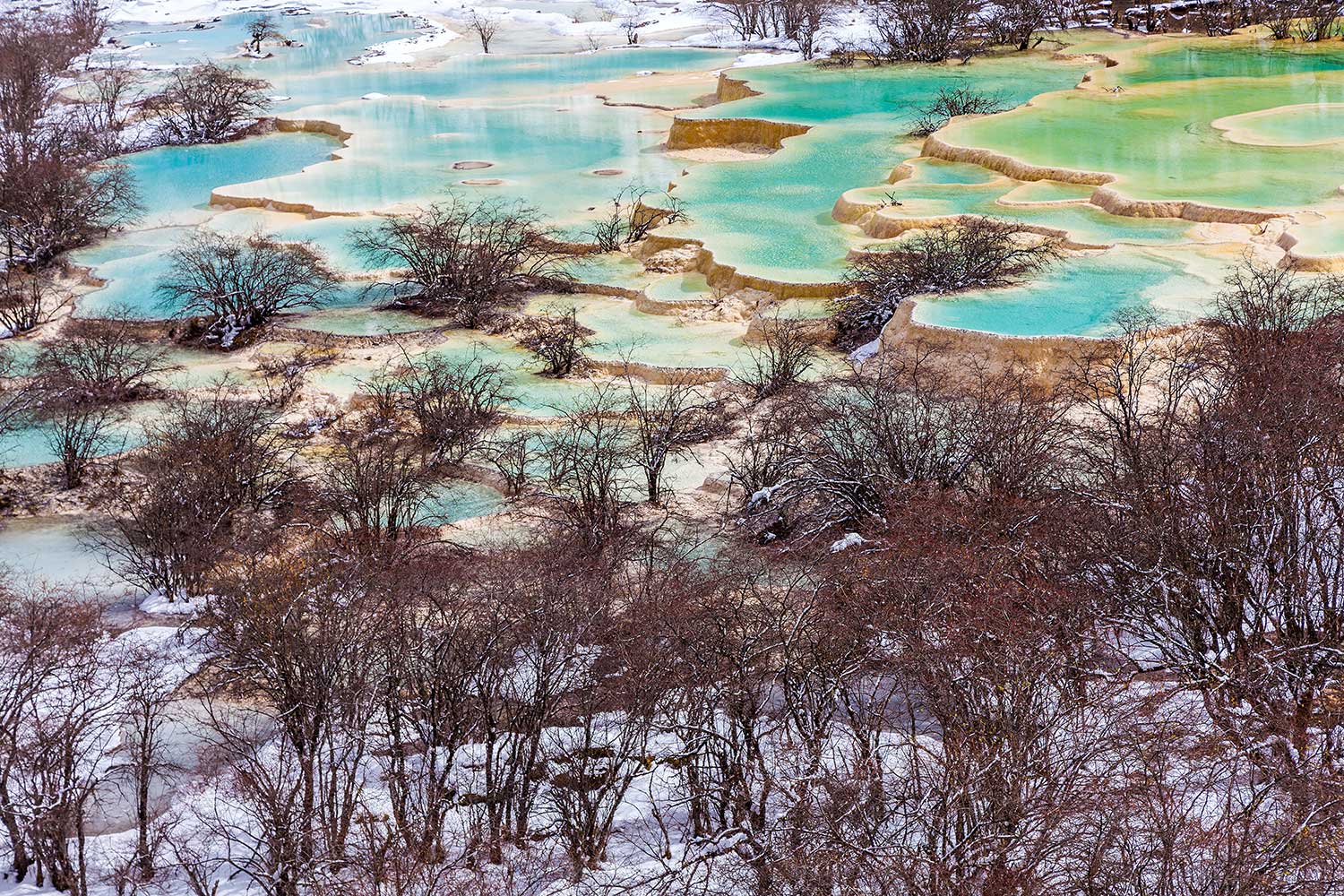
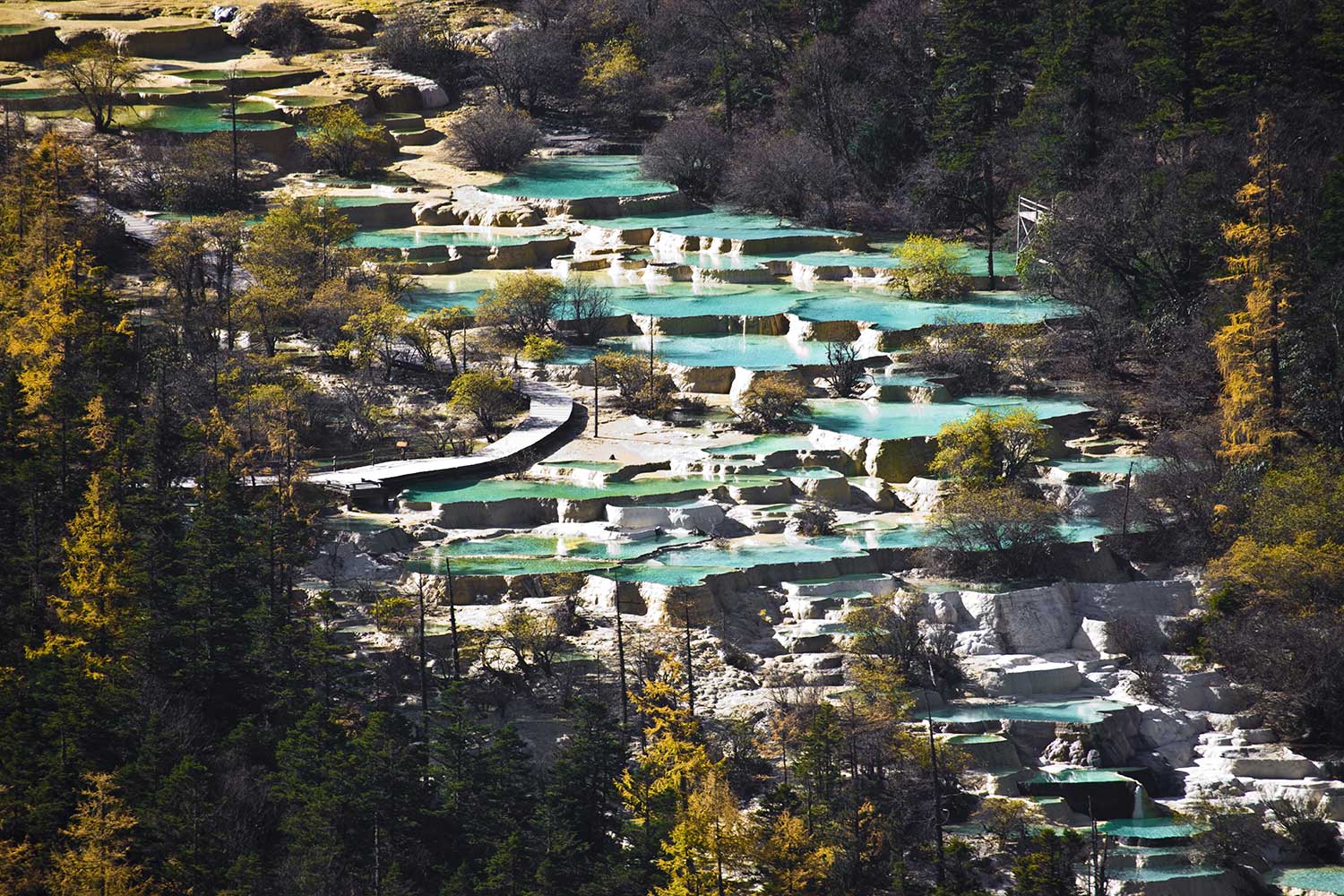
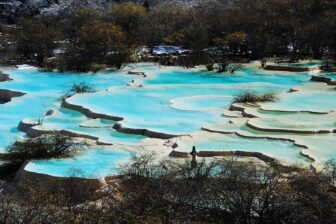
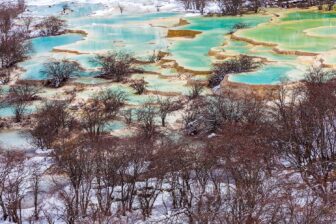
Drive to Huanglong (2 hours). Discovery of Huanglong National Park, composed of impressive karst formations. Surface calcification is the main landscape of the Huanglong Valley, with thousands of pools and calcified banks resembling a golden dragon flying out of the forest. Enclosing dikes form various pools; snowmelt flows along the calcified tiers like terraced fields or fish scales. The water colors shift depending on the sediment, trees, and mountains, appearing yellow, green, light blue, azure, etc. Ascend by cable car, followed by a 50-minute walk to arrive at the Five-Colored Lake at 3,550 meters altitude. Then, allow about 2.5 hours of normal walking through a small but sumptuous valley with its terraced limestone pools to tour the area and descend to the bus without the cable car, in order to admire the landscape. Transfer to Huanglong-Jiuzhai Station, departure by high-speed train C5768 (17:59–19:52) to Chengdu. Arrival at Chengdu East Station, greeting by your driver, and transfer to the hotel. Overnight: Wenjun Courtyard.
Day 5: Chengdu – Dujiangyan (Breakfast) | Altitude: 720m
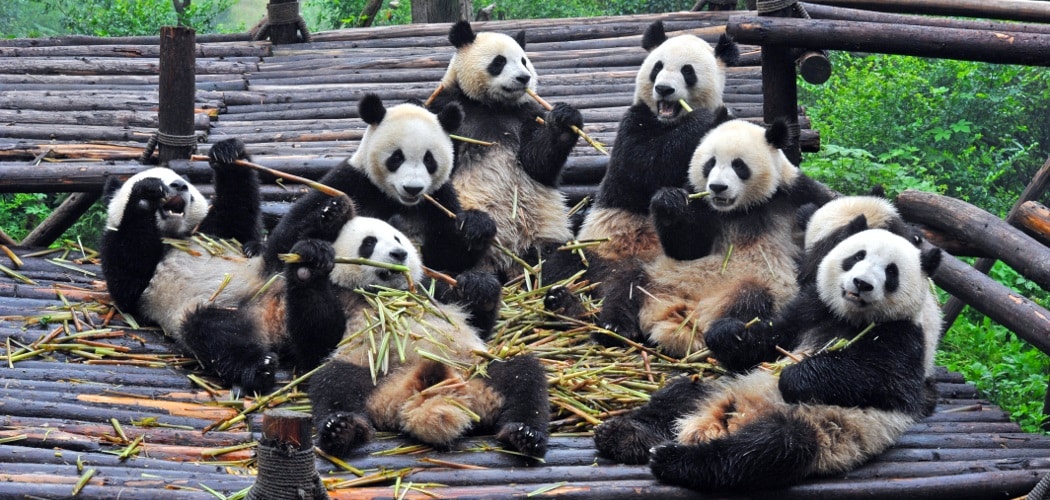
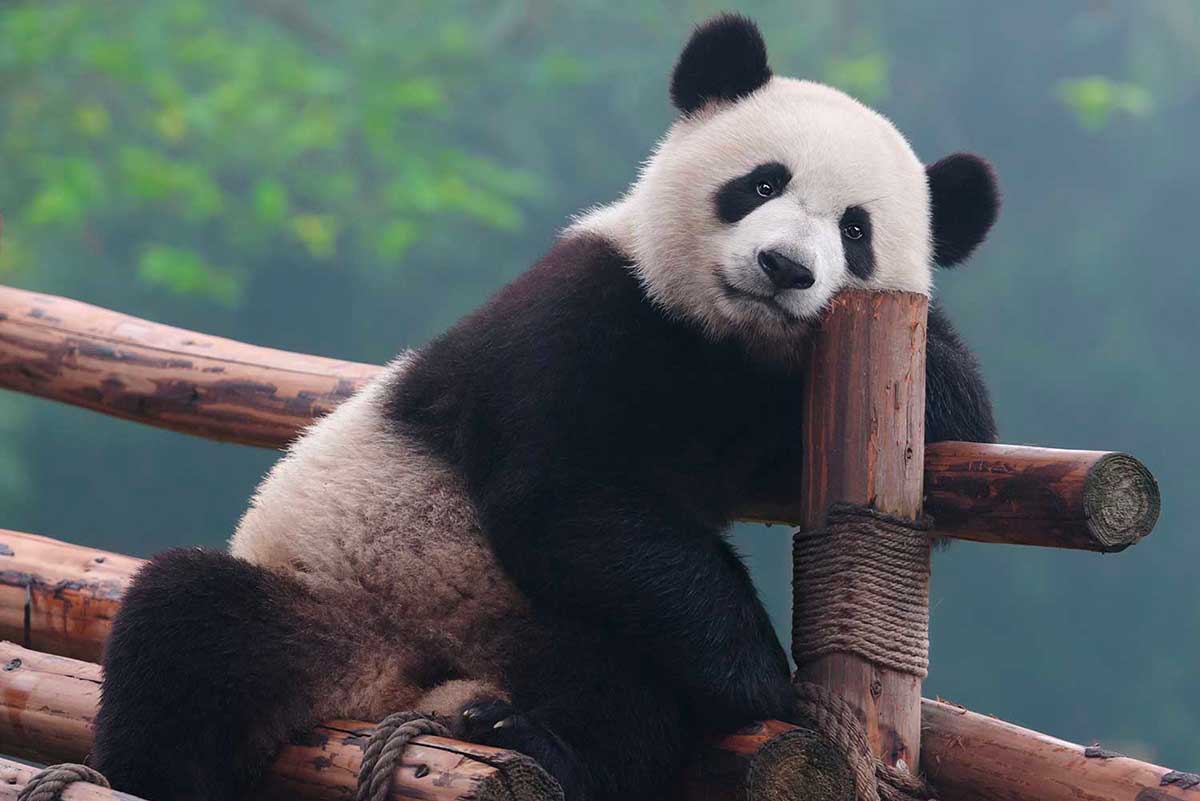
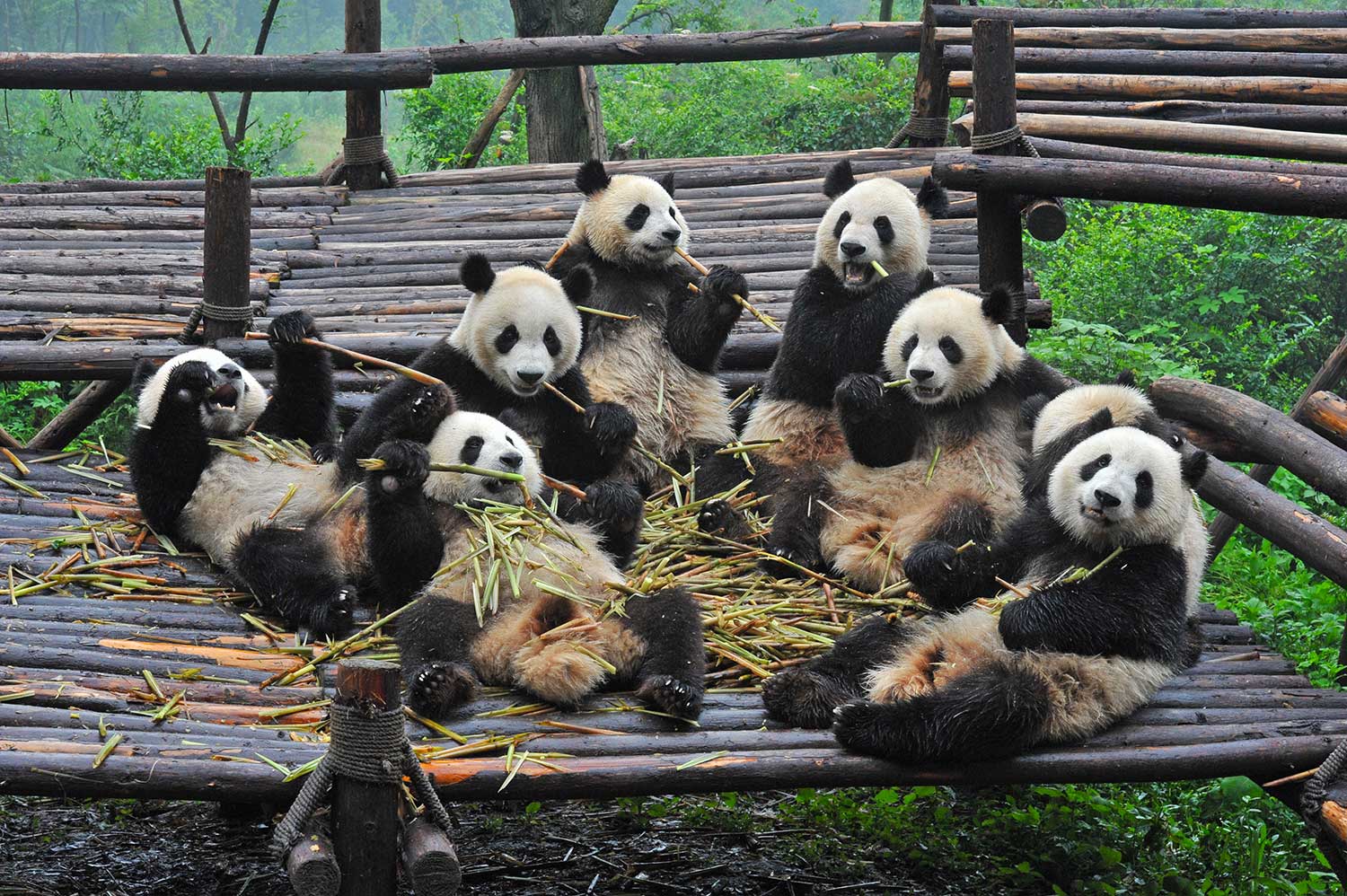
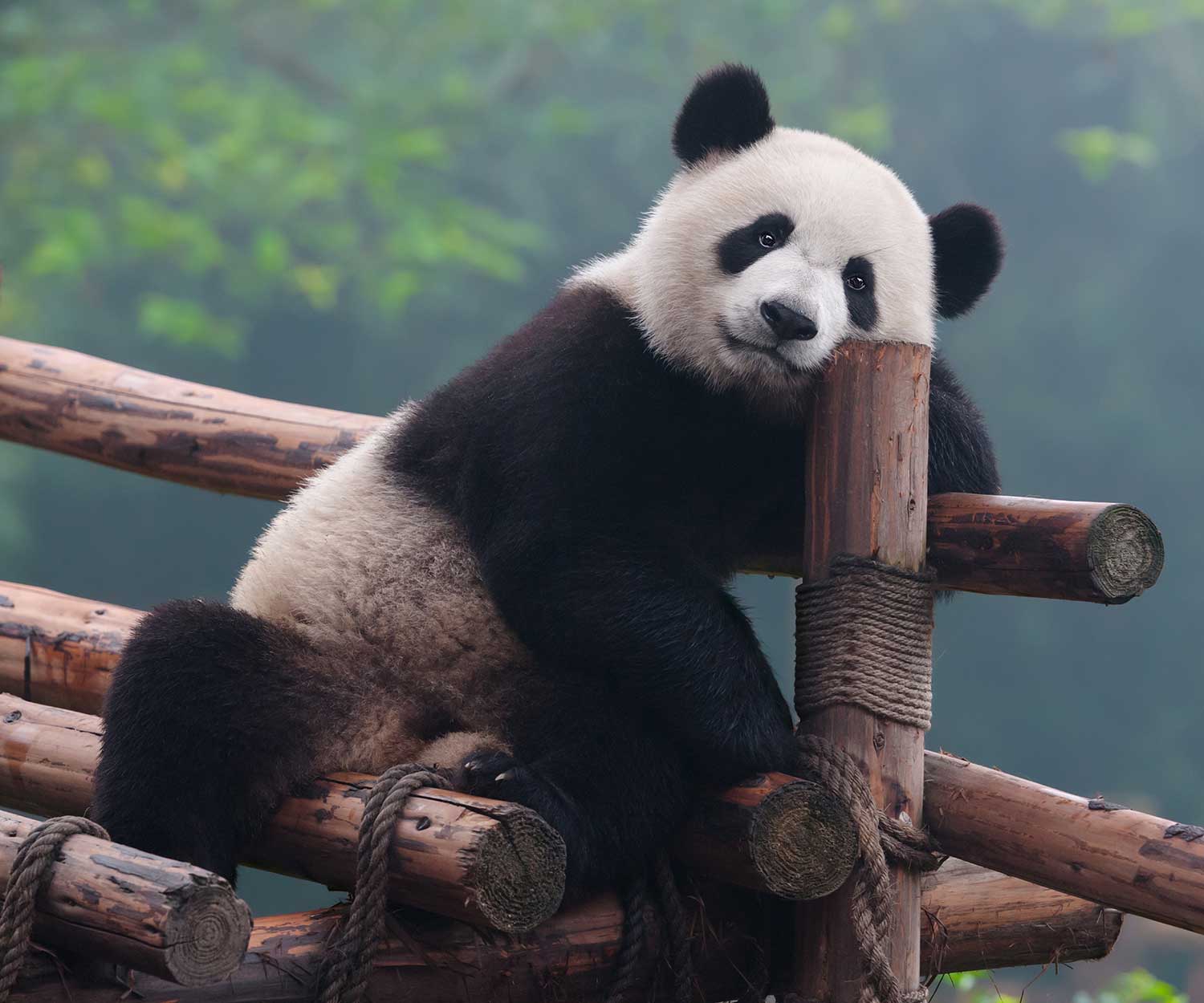
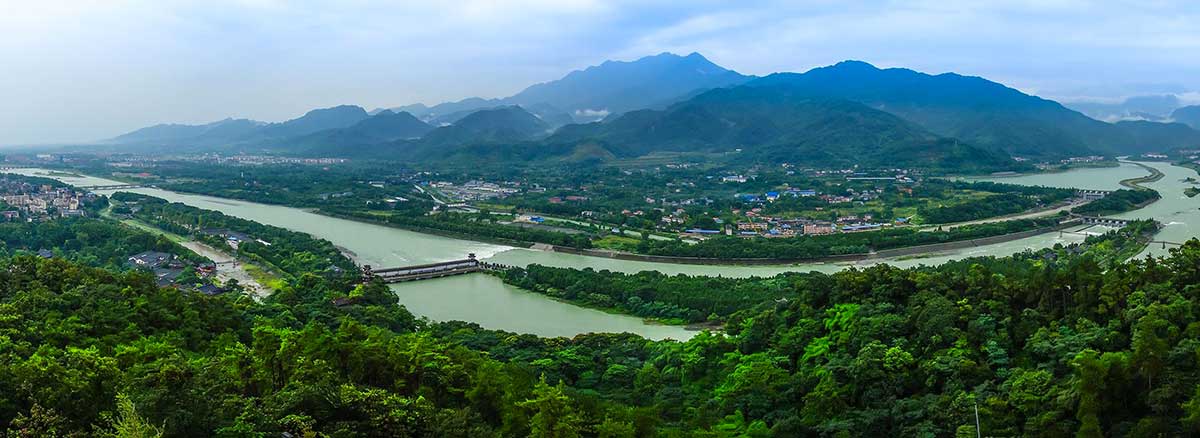
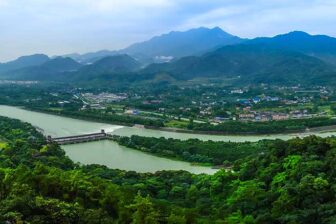
Drive to Dujiangyan (1.5 hours). Visit the Dujiangyan Panda Park. In 1869, French missionary Armand David discovered the Giant Panda in Sichuan. Subsequently, this animal became known to Western society. Visitors marvel at the sight of pandas, both young and old, playing, chasing each other, devouring bamboo stems, or simply sleeping in touching poses. Discovery of the Dujiangyan Irrigation System, inscribed as a UNESCO World Heritage site in 2000. Before the construction of the Dujiangyan irrigation system, the Chengdu plain was submerged by the waters of the Min River in summer and prone to drought in winter. Designed in 256 BC by Li Bing, prefect of the State of Shu, to harness the waters of the Min River, the irrigation system has transformed the Chengdu plain into one of the most fertile plains in the country for nearly 2,200 years. Stroll through Dujiangyan Old Town. Overnight: Home 2 Suites By Hilton Chengdu Dujiangyan.
Option: Volunteer day at the Dujiangyan Panda Park (Rate: 840 RMB per person). Authorized age for participation: between 8 and 70 years old.
Day 6: Dujiangyan – Leshan – Emeishan (Breakfast) | Altitude: 550m
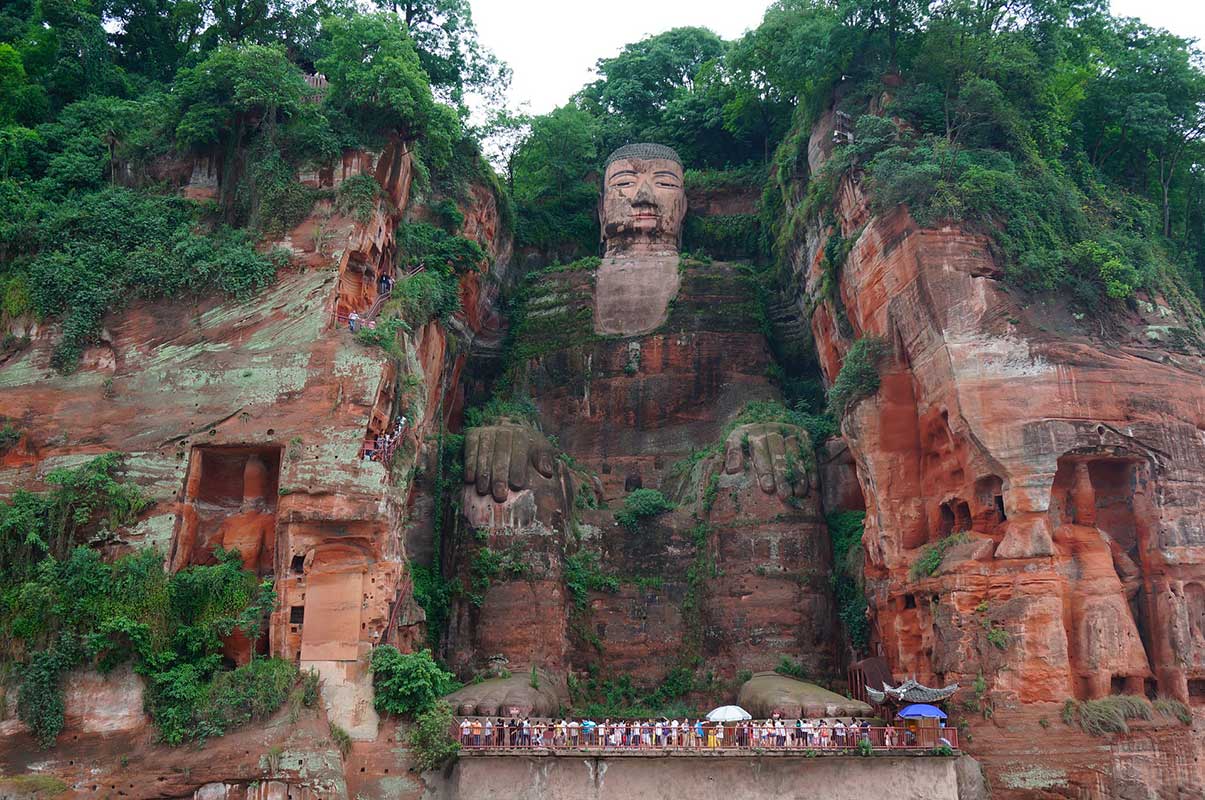
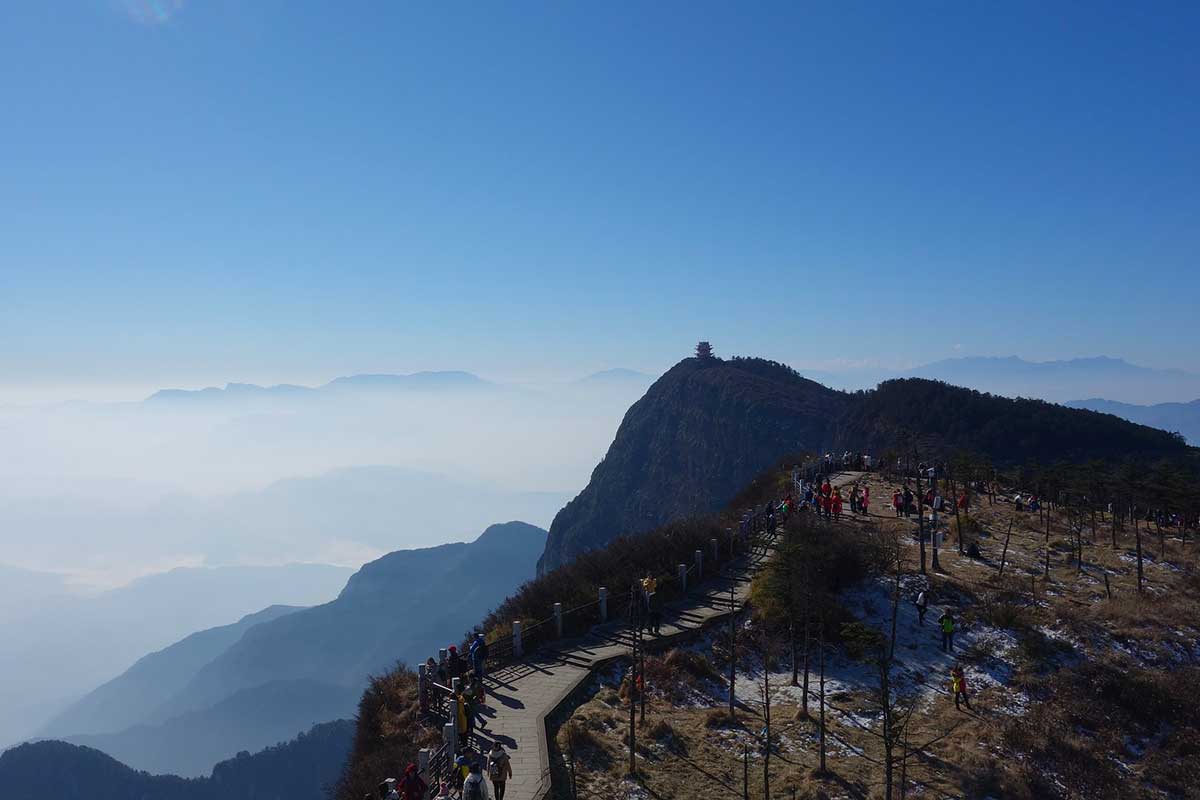
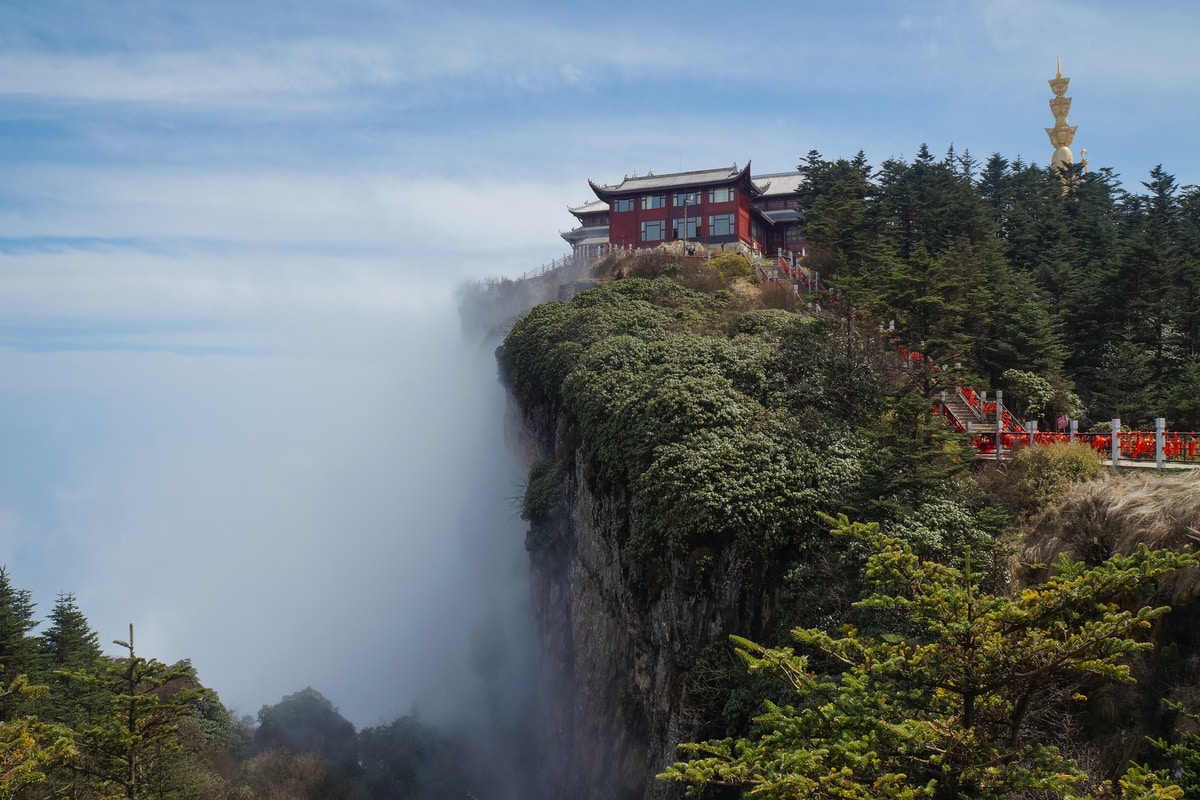
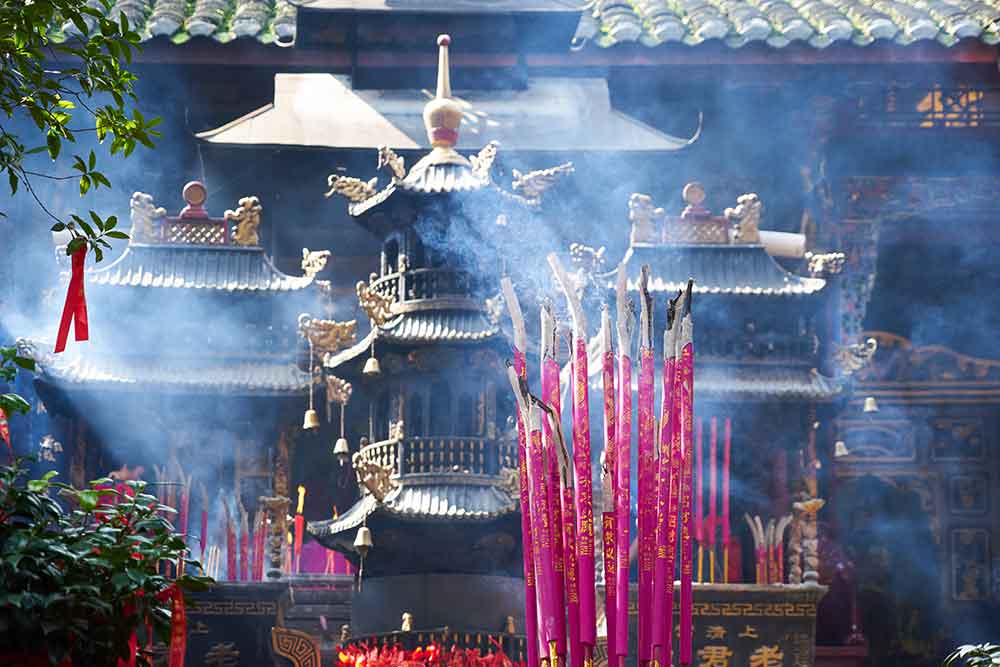
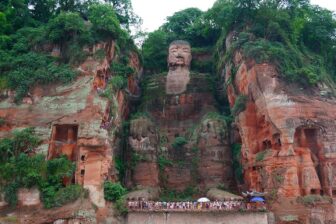
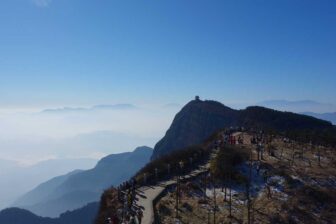
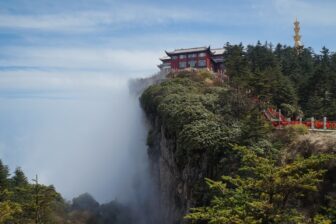
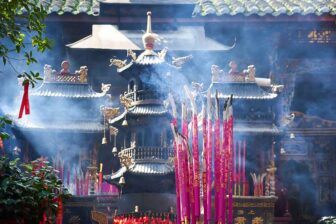
Drive to Leshan (2.5 hours). Inscribed as a UNESCO World Heritage site in 1996, the Leshan Giant Buddha overlooks the confluence of the Min, Dadu, and Qingyi rivers, where treacherous whirlpools once formed. Haitong, the monk behind the sculpture begun in 713, hoped it would appease the anger of the waters. As the largest stone Buddha in the world, it stands 71 meters tall. River cruise on the Min River to admire the panoramic view of the Giant Buddha and the beautiful surrounding landscapes. Walk up to the Buddha’s head and visit Lingyun Temple and the Giant Buddha. Drive to Mount Emei (1 hour). Mount Emei, one of China’s four sacred Buddhist mountains, has always been a major pilgrimage site, evidenced by the large number of temples and monasteries built on its slopes. The Golden Summit at 3,077 meters is often hidden by fog. The Bodhisattva Puxian is the protector of Mount Emei. Visit Fuhu Temple (Crouching Tiger Temple), a nunnery. Located at 630 meters altitude, it houses 500 terracotta Arhats with incredibly varied expressions and postures. Inside the temple stands a 7-meter-tall bronze pagoda bearing 4,700 images of the Buddha as well as the text of the Huayan Sutra. Overnight: Jingzhu Shiguang Hotspring Hotel.
Day 7: Emeishan (Breakfast) | Altitude: 550m
In the morning, departure by shuttle bus to Leidongping Station (2-hour mountain drive), arrival at the Golden Summit at 3,077 meters altitude; ascent and descent by cable car. Visit Huazang Temple and the great statue of Puxian. The great bronze statue of the Bodhisattva Puxian is 48 meters high and weighs 660 tonnes. Time permitting, visit Baoguo Temple. Located at the foot of Mount Emei, this temple was built in 1573 during the Ming Dynasty (1368–1644) and rebuilt during the Qing Dynasty (1644–1911). The main buildings of the temple lean against the mountainside. The temple houses a porcelain statue of the Bodhisattva Puxian, 3.5 meters high and made in 1415. The temple’s inner garden is magnificent, with flowers, rare plants, and bonsai. Return to the hotel. Overnight: Holiday Inn Express Emei Mountain.
Day 8: Emeishan – Luocheng – Lizhuang – Shunan Bamboo Sea (Breakfast) | Altitude: 311m
Drive to Luocheng (1.5 hours). Visit the Ancient Town of Luocheng, shaped like a boat, with its streets lined with houses supported by wooden columns in the Ming and Qing architectural style. Elderly locals spend their free time in the traditional tea house. Tea tasting with the locals. Continue to Lizhuang (2 hours). Arrival in the afternoon at the old village of Lizhuang, on the banks of the Yangtze. Discovery of Lizhuang, which was the relocated center for Tongji University during the Anti-Japanese War. Continue to the Shunan Bamboo Sea (1 hour). The Bamboo Sea, a Chinese national park located in Sichuan province, covers 28 mountains with over a thousand peaks and reaches an area of 4,000 hectares. It is best known for its variety of bamboo, totaling over 30 species, and has become a tourist destination notably thanks to the film Crouching Tiger, Hidden Dragon. It presents a magnificent landscape of mountains, caves, lakes, and waterfalls, as well as cultural sites. Overnight: Chanyi Guiyunju Hotel.
Day 9: Shunan Bamboo Sea – Zigong (Breakfast) | Altitude: 400m
Departure in the morning for the Bamboo Sea. Upon arrival, visit the Bamboo Culture Museum. Then, take a panoramic cable car ride over the bamboo forest. Visit the Xianyu Caves, where one can admire Buddhist and Taoist statues. Visit the Seven-Colored Waterfalls and other sites. Continue to Zigong (2 hours). The history of Zigong is closely linked to the salt industry, and the city is well known for its 1,900 years of historical salt manufacturing. Here, people began drilling wells to obtain salt as early as the Eastern Han Dynasty (25–220). It made a name for itself as the Salt Capital since the Western Jin Dynasty (265–316). In 1835, it had the first salt well in the world to exceed one thousand meters in depth, at a time when the region’s salt production reached its peak. Zigong was the first city in the world to exploit and use natural gas. Overnight: Huidong Hotel.
Day 10: Zigong – Anyue (Breakfast) | Altitude: 325m
Visit the Zigong Salt History Museum, built by the Shanxi Merchants Guild in 1736. Visit the old village of Xianshi, composed of typical buildings and guilds from different provinces. Xianshi was the pier used to transport salt. Drive to Anyue (1.5 hours) through the Chinese countryside, abundant with rice paddies and terraced crops. Visit Yuanjue Cave, whose ornamentation began under the Tang, continued under the Five Dynasties, and then the Song. Overnight: Anyue Jinjiang Hotel.
Day 11: Anyue – Dazu (Breakfast) | Altitude: 370m
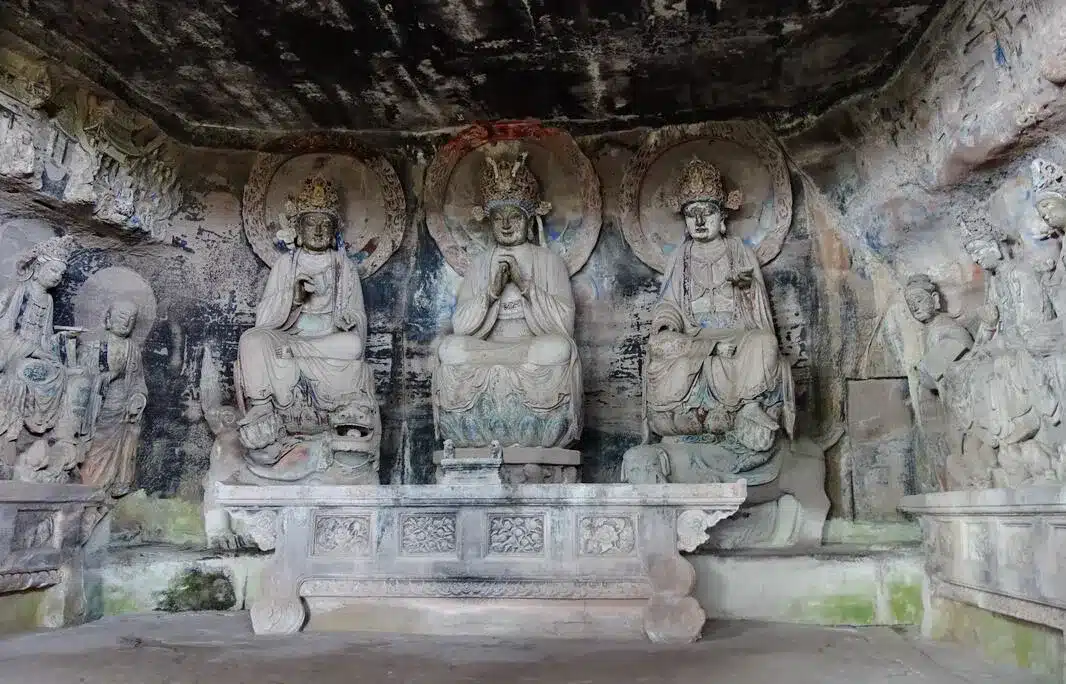
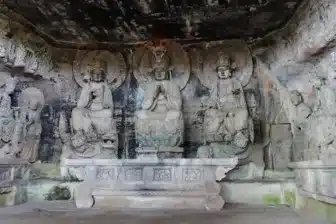
Departure for the Anyue Reclining Buddha (40 minutes). Access to the site via a newly opened road. The sanctuary, dating from the 9th–11th centuries, is sculpted over a length of 850m on a cliff face 5m high. It features a large reclining Buddha 23m long, surrounded by numerous bas-reliefs. On the road to Dazu, visit another Buddhist sanctuary complex: Pilu Cave, which houses the finely modeled statue of Guanyin with Black Bamboo. Continue to Dazu. Discovery of the UNESCO-listed Buddhist caves, as renowned as those of Dunhuang or Longmen. Thousands of bas-reliefs and statues with Buddhist, Taoist, and Confucian influences are spread across some forty sites. The earliest works are said to date from the Tang Dynasty (9th century) and the latest from the late Song (13th century). Visit the Bei Shan (North Mountain) rock carving site. This older site (9th century) is more fragile: it is protected under a shelter. It represents scenes of more modest size, with Taoist and Confucian themes. Here too, there are over 10,000 statues (distributed in 190 caves) over a distance of 500m. They were created over a period of 250 years. Overnight: Grand House Hotel.
Day 12: Dazu – Baodingshan – Wulong (Breakfast) | Altitude: 500m
Departure for Baodingshan (30 minutes). Visit the Baodingshan rock carving site. Located at the edge of a U-shaped gorge, this site houses two groups of sculptures considered the pinnacle of Chinese rock carving, among which the Avalokitesvara with 1,000 arms (actually 1,007) stands out exceptionally. It was entirely realized by one man, Zhao Zhifeng, who dedicated over seventy years (1179–1249) to collecting funds to sculpt these statues. There is no other known example of rock ensembles created in such large numbers in so little time. It is the last site of this type created in China. Departure for Wulong (3.5 hours). Arrival in Wulong and check-in at the hotel. Overnight: Tianyi Fangcaodi Holiday Hotel.
Day 13: Wulong (Breakfast)
In the morning, discovery of Longshui Canyon. Formed by orogenic movements tens of millions of years ago, Longshuixia Canyon in Wulong is characterized by its deep canyons, primitive vegetation, waterfalls, crystal-clear streams, and natural pools with rushing currents. The landscape is delicate and magnificent, where majestic mountains, steep peaks, deep canyons, and whitewater compose a perfect natural painting. From the bottom of the canyon, the cliffs reveal only a thin strip of sky. Throughout the journey, one can admire numerous formations shaped by nature over millions of years, such as the Frozen Dragon Cave or the Moon Reflecting Lake, each telling of geological evolution. In the afternoon, discovery of the Three Natural Bridges of Wulong. A UNESCO World Heritage site, this karst landscape is distinguished by its three majestic natural bridges crossing a deep canyon like a procession of mineral dragons: Tianlong Bridge (Celestial Dragon), Qinglong Bridge (Green Dragon), and Heilong Bridge (Black Dragon). Their alignment constitutes a rare geological phenomenon, traditionally described as “three bridges spanning two depressions.” Each displays unique visual power, combining grandeur, elegance, and mystery, contributing to the enchanting atmosphere of the place. This spectacular natural setting also served as a backdrop for international cinema, appearing in films such as House of Flying Daggers by Zhang Yimou and Transformers 4: Age of Extinction. Hidden under the monumental arch of Tianlong Bridge, the Tianfu Post House is the only exterior set piece preserved from the film, poetically inserting a page of human history into this millennial mineral epic. Overnight: Tianyi Fangcaodi Holiday Hotel.
Day 14: Wulong – Chongqing (Breakfast)
In the morning, visit Furong Cave. Inscribed by UNESCO in 2007, Furong Cave is frequently compared to a “subterranean art palace.” Formed about 1.2 million years ago on the banks of the Furong River, it extends for 2,700 meters, of which 1.8 km are specially arranged for visitors, covering a total area of 37,000 m². It houses an exceptional diversity of karst formations (over 70 types of concretions), such as stalactites, stalagmites, draperies, calcite waterfalls, and stone flowers. Thanks to artistic lighting that delicately highlights forms and textures, the cave offers an immersive and dreamlike experience, inviting you to dive into a fantasy world sculpted by time and water. This natural museum combines beauty and geology to create one of China’s most captivating underground landscapes. Continue to Chongqing (2.5 hours). Stroll through the Jiefangbei Pedestrian Street, the city’s most lively and symbolic commercial center, known as the “First Street of Western China.” Its central point is the People’s Liberation Monument, initially erected in 1940 to commemorate the resistance against Japan and renamed in 1950 to symbolize peace and liberation. In the evening, walk at Hongyadong, the most magical and emblematic place in Chongqing. This complex reproduces the traditional Diaojiaolou architecture, wooden stilt houses on the hillside by the Jialing River. With its 11 floors, its appearance recalls a building from the anime Spirited Away. At night, Hongyadong lights up, appearing to float like a golden palace above the water. Overnight: Chongqing Dashijie SSAW Boutique Hotel.
Day 15: Chongqing (Breakfast)
Visit the Three Gorges Museum, considered a three-dimensional “encyclopedia” of the Three Gorges and a treasure trove recording the historical changes of Chongqing. Its main building, facing the Great Hall of the People of Chongqing and the People’s Square, forms an emblematic architectural ensemble of the city, with a location of great importance. Visit Liziba Metro Station and the phenomenon of the metro passing through a residential building. Liziba Station on Chongqing Metro Line 2 is the first elevated monorail station in China built in coexistence with a commercial and residential building. The train passes through the intermediate floors (6th–8th), creating the unique visual phenomenon of an “aerial train crossing a building.” Liziba Station is a classic example for perceiving Chongqing’s “magic 8D topography.” Visit the old district of Ciqikou, located on the banks of the Jialing River, whose name means “Porcelain Port,” in reference to its history of porcelain production and trade during the Ming and Qing Dynasties. With its unique topography—”one river, two tributaries, three hills, four streets,” its steep alleys, and stilt houses—it represents the mountainous and port charm of Chongqing, known as “Little Chongqing.” Do not miss tasting the Chen family’s twisted dough sticks (Mahua), a crispy and tasty local specialty. Return to your hotel in the center of Chongqing. Free evening. Overnight: Chongqing Dashijie SSAW Boutique Hotel.
Day 16: Chongqing – Departure
Transfer to Chongqing International Airport (without guide) for your return flight. End of our services. We wish you a pleasant journey home and many memories in mind!